Innovative antimicrobial technology kills microorganisms
Dr. Marie-Lena Harwardt, Martin Danz, Oliver – Heraeus Precious metals
Microorganisms can pose a significant health threat as well as seriously harm the economy. Every year, approximately 11 million people die from sepsis, which corresponds to around one in five deaths worldwide. Sepsis can occur as a result of the body´s reaction to an infection. These risks can be reduced by antimicrobial technologies in various areas, such as medical devices, public transport and buildings, water filtration, and other applications.
However, microorganisms not only affect the health of humans and animals, but they also cause enormous economic damage every year due to biocorrosion and fouling. Biocorrosion and fouling can lead to plant damages, loss of quality and performance of products as well as increased consumption of raw materials and energy.
Every year around 20% of the economic damage caused by corrosion can be traced back to biocorrosion, which corresponds to an annual damage of approximately 307 billion Euro. In order to prevent biocorrosion and fouling, antimicrobial technologies are used to ensure the functionality of equipment and enhance the quality of the goods produced.
Heraeus offers AGXX – a superior antimicrobial technology – to combat the threat of a worldwide spread of health-endangering germs. The technology promises an outstanding antimicrobial effect and delivers more benefits in comparison to conventional antimicrobial solutions, such as silver-ion- or silver-nano-based products.
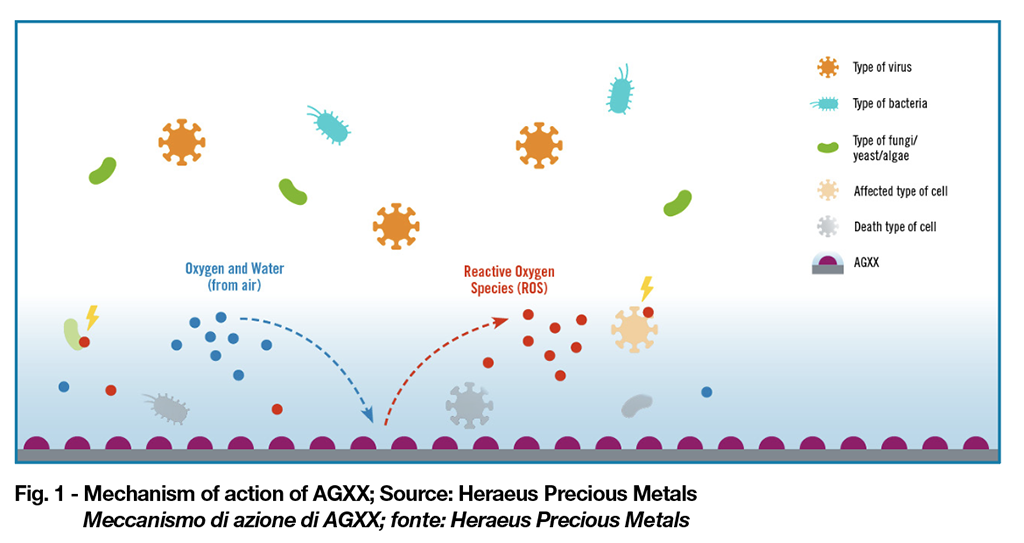
The antimicrobial technology provides broadband effect by comprehensively killing a wide range of microorganisms, such as bacteria, fungi, algae and viruses. It also has a long-lasting effect as its mechanism of action is based on the release of metal ions into the environment. These properties make it ready for a regulatory-compliant use in a wide range of applications.
HOW DOES IT WORK?
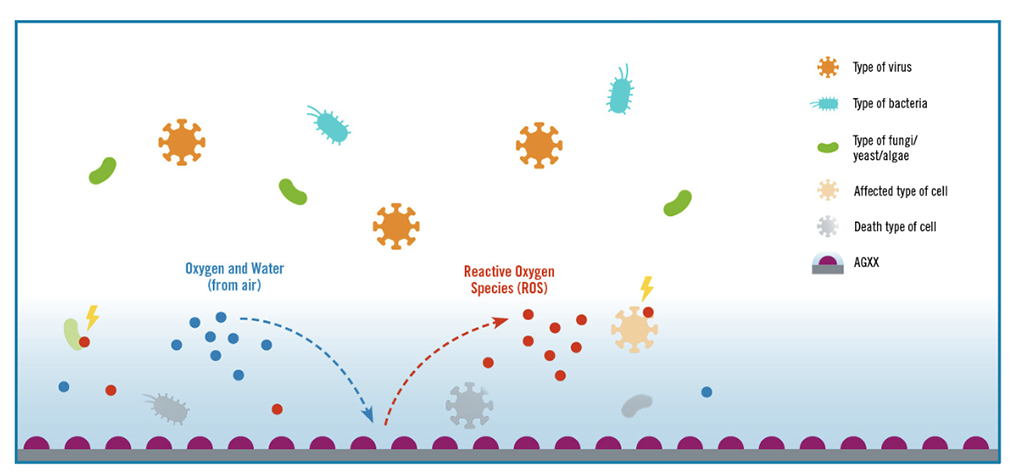
AGXX is a highly efficient, catalytically driven antimicrobial technology, based on redox reactions and microelectric field effects on the interaction of two precious metals. In the presence of air humidity, oxygen is converted into reactive oxygen species (ROS), which react with the microorganisms and kill them. In addition, the existing microelectric field affects important functions of the cell membrane and accelerates the killing of the microorganisms.
The antimicrobial effect of AGXX has been successfully tested against more than 130 microorganisms, including silver- resistant bacteria.
Unlike, for example, classical silver systems, this antimicrobial technology does not allow the formation of any resistance as it is not based on the release of metal ions.
POTENTIAL APPLICATIONS
The antimicrobial technology is ideally suited for incorporation into multiple materials and coatings due to its particle form, available as dry powder and suspension. The particles consist of a carrier material modified by impregnation with the two catalytically active precious metals. The particles are available on a variety of carrier materials, such as inorganic material as aluminum oxide, cellulose or also on activated carbon. Particle sizes range between 0.1 µm up to 3 mm granules. This product variety enables the application in a wide variety of application fields, including paints and coatings, filters, polymers, and textiles.
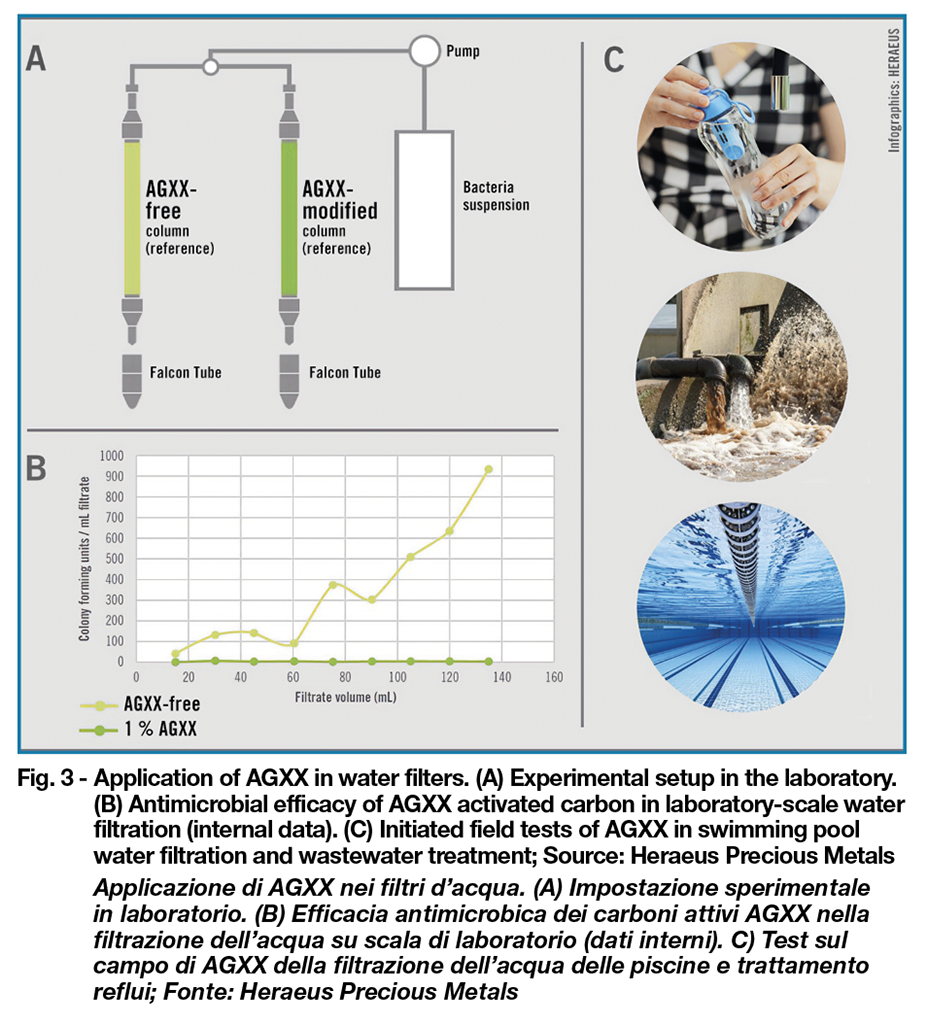
In line, the use of this antimicrobial technology was tested successfully in water filter applications. Especially in aqueous media, pathogens can spread rapidly and become a danger to humans and the environment. To ensure a high-quality water supply, water filtration, such as in drinking water supply, wastewater treatment or household filter applications, therefore plays a crucial role. AGXX prevents the formation of biofilms on the surface of filters, the spread of dangerous microorganisms in the filtered water and protects the filter itself from corrosion. This antimicrobial technology can be successfully impregnated onto various types of activated carbon granules and pellets, which can be easily used in activated carbon-based water filters. In various ASTM and laboratory water filtration tests, the activated carbon granules showed excellent antimicrobial efficacy for the protection of filters as well as water purification.
 Regarding AGXX application in paints and coatings, this technology has successfully demonstrated long-lasting antimicrobial activity in various pot preservation trials. Whereas classical paint preservatives release organic chemicals or metal ions, the particles will not leach out, thereby having an immense advantage for the regulatory compliance, human health, the environment and economy. With regard to its efficacy in pot preservation, independent laboratories have carried out tests in accordance with IBRG-P16 (International Biodeterioration Research Group). The paints treated in this way showed an excellent antimicrobial effect, so that no microbial growth was detectable on the paints, even after several weeks or inoculations.
To prove the functionality of the product as a film preservative, tests according to ISO 22196 against S. aureus and E. coli as well as against fungi were carried out. For this purpose, AGXX was incorporated into a biocide-free interior paint and into a biocide-free polyurethane varnish which both resulted in good antimicrobial results. Thus, paints and varnishes with pot and film preservation can be provided without leaching of environmentally harmful substances.
In addition to the antimicrobial efficacy of a preservative, it is important that the added additive does not impair color fastness as only low concentrations of the product is required, especially in pot preservation. In order to demonstrate color fastness when using the technology, accelerated weathering tests (QUV tests according to ISO 16474-3) were carried out. For this purpose, the AGXX-containing samples were stored for 500 hours in a weathering tester and subjected to weekly color determination in comparison with the AGXX-free reference. The final result showed hardly any differences between the color of the antimicrobially modified paint and the AGXX-free reference.