PTFE-free wax additives for scratch-free surfaces

Philipp Teriete, Brigitte Weber – BYK

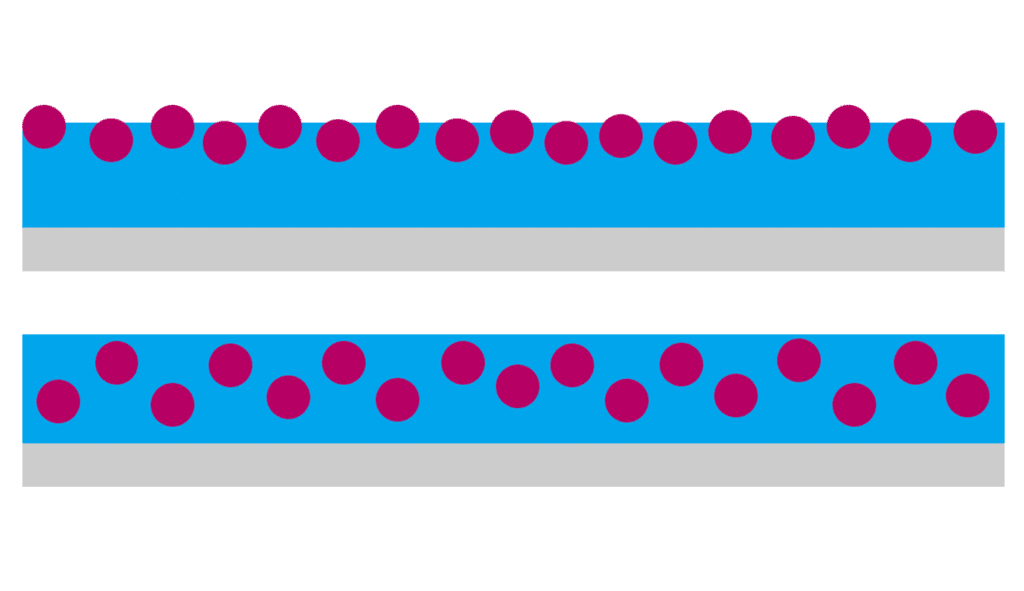
Polytetrafluoroethylene (PTFE) is a substance with a unique behavior in coatings applications. It is used in all types of coatings to modify total mechanical performance, while simultaneously lowering surface friction. If PTFE is used as an additive for paints and coatings, it has only a minor influence on gloss values or other optical properties and is suitable for food contact applications. Thanks to the higher density of PTFE, the wax additives can orientate throughout the entire coating film, in contrast to a number of other wax additives that orientate to the paint surface and only interact within the interfaces between the coating and the air (Fig.1).
PTFE-based wax additives are typically delivered in a micronized form or as a dispersion type in organic solvents.(1,2)

Why is it better to replace PTFE-based substances in coatings applications?
Polytetrafluoroethylene is a well-known representative of perfluoroalkyl and polyfluoroalkyl substances (PFAS). This large group of synthetic chemicals has a wide range of use in our modern society. They can be found in textiles, surface treatments, and impregnation. PFAS are used in high-performance fire-protection clothing and firefighting foams, in everyday appliances and food packaging to implement antistick properties. Furthermore, these substances are used in various paints and construction materials to improve durability.

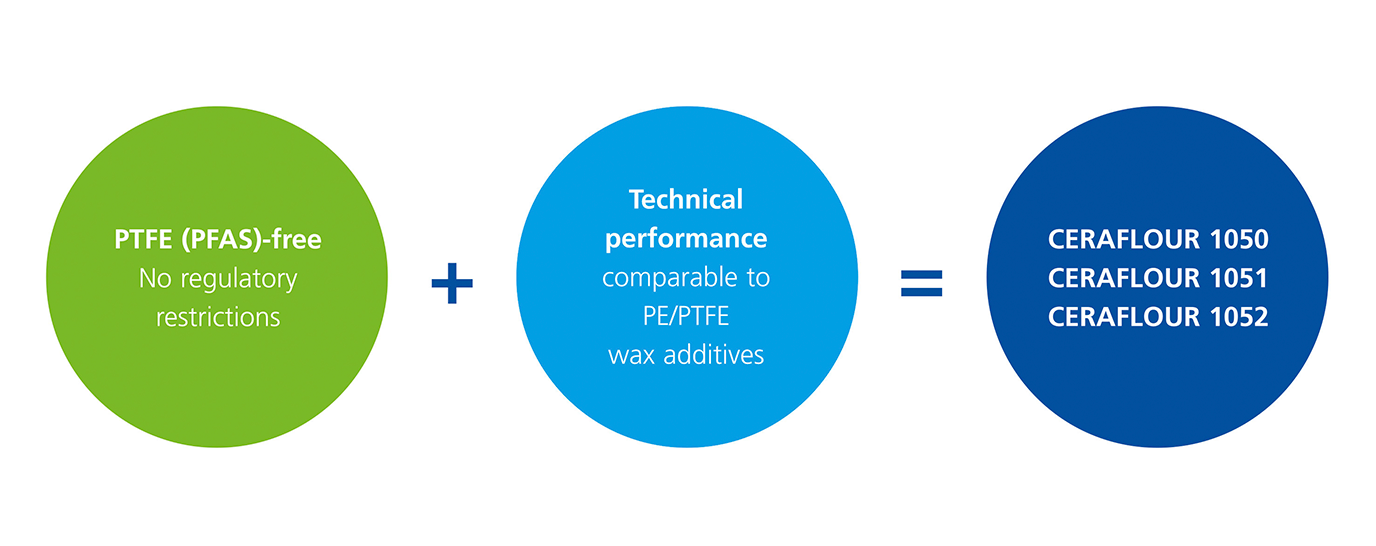
Fig. 2 – New PTFE-free wax additive family members

Polytetrafluoroethylene is a well-known representative of perfluoroalkyl and polyfluoroalkyl substances (PFAS). This large group of synthetic chemicals has a wide range of use in our modern society. They can be found in textiles, surface treatments, and impregnation. PFAS are used in high-performance fire-protection clothing and firefighting foams, in everyday appliances and food packaging to implement antistick properties. Furthermore, these substances are used in various paints and construction materials to improve durability.
Despite boosting several properties in these application fields, PFAS come with downsides. Some PFAS are toxic to humans and are also well-known environmental pollutants. They are very resistant and persistent to degradation. This is good for generating long-lasting properties in coatings applications, but harmful to the environment. Studies have shown that PFAS can easily contaminate water sources and soil. In addition, these substances can often be found in human blood. Tests indicate that PFAS can weaken the immune system and are linked to elevated cholesterol levels and liver damage. As a result, global regulatory bodies began to investigate PFAS-containing polymers and made it a global topic to increase concern about the use of PFAS. Global regulatory leaders such as the European Chemical Agency, United States Environmental Protection Agency, and the Ministry of Ecology and Environment of People’s Republic of China have already launched restrictions, limitations, bans, and directives on the use of PFAS.(3-8)

PTFE-free alternatives – Introduction of new family members
Although PTFE is a substance with unique properties, there are alternatives available that have been developed as replacement solutions for typical PE/PTFE wax additives. BYK’s new wax additives provide comparable performances with a focus on improving mechanical resistance. They offer a system-dependent reduction of coefficient of friction (COF) while suitable for food contact applications. These three new developed alternatives are now available for direct comparison to existing PTFE-based standard wax additives (Fig.2). All three products are micronized to a very fine particle size of D90:10µm. This provides reproducible performance in a variety of different application areas. Ceraflour 1050 uses a PE wax base and is especially recommended for clearcoats and haze-sensitive systems. Ceraflour 1051 uses a modified PE alloy as wax base and shows the best results over a wide range of application areas. Ceraflour 1052 uses a modified PE alloy as well and is recommended for systems with a lower COF demand.

Technical performance of new family members
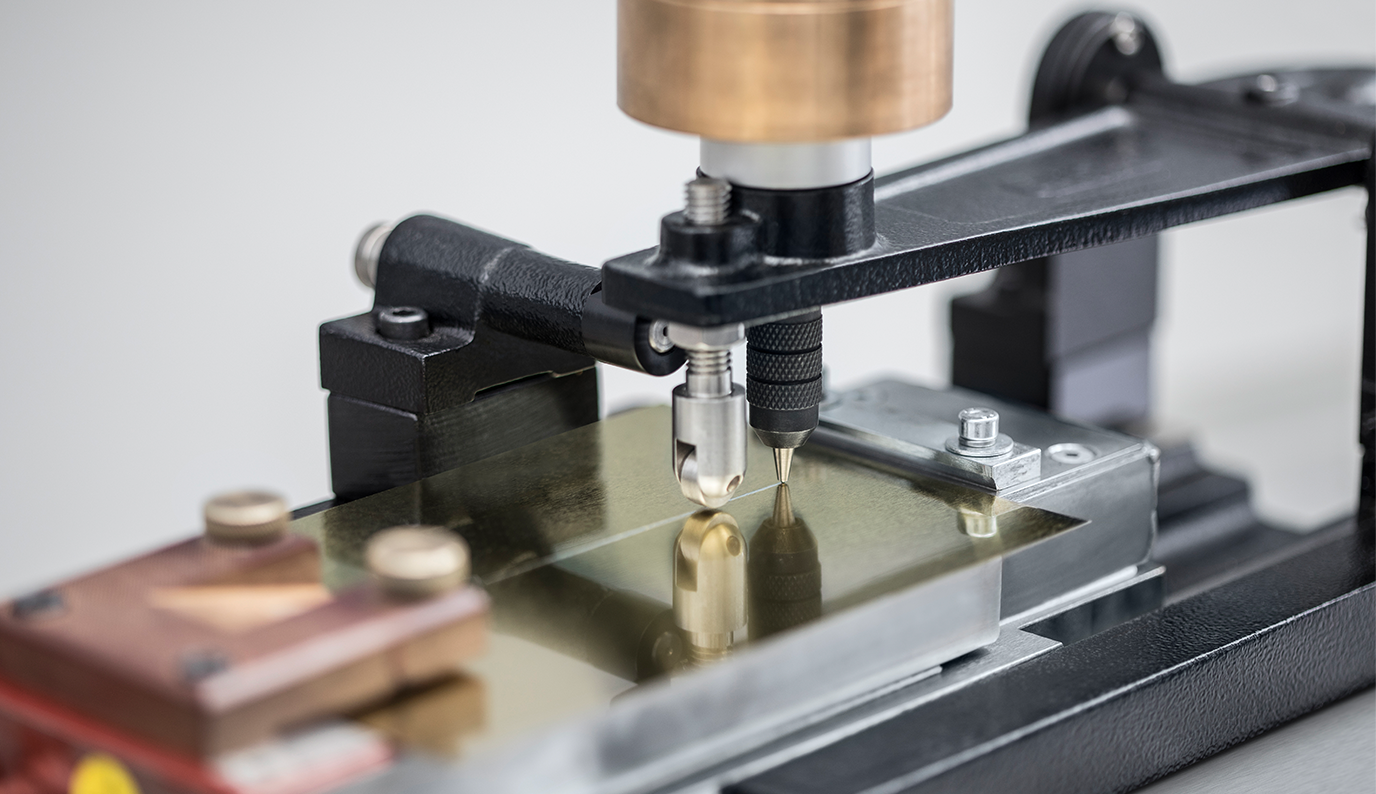
All developments were carried out in different testing systems and application areas where mechanical performance is important. Food and beverage cans should protect their filling for several years. Can interiors are typically coated with an organic layer that protects the integrity of the can from the effects of the food. On the other hand, the exterior is also coated to prevent the can from becoming damaged during storage or transportation. This means that interior and exterior coatings need to fulfill specific requirements with regard to scratch resistance and COF values. The test against scratch resistance in the can industry is performed using the TQC-sheen-mechanized scratch tester 705 (Fig.3). A test panel is clamped down and slowly moved while a defined needle scratches the surface n (Fig. 3).(9)


Fig. 3 – TQC-sheen scratch

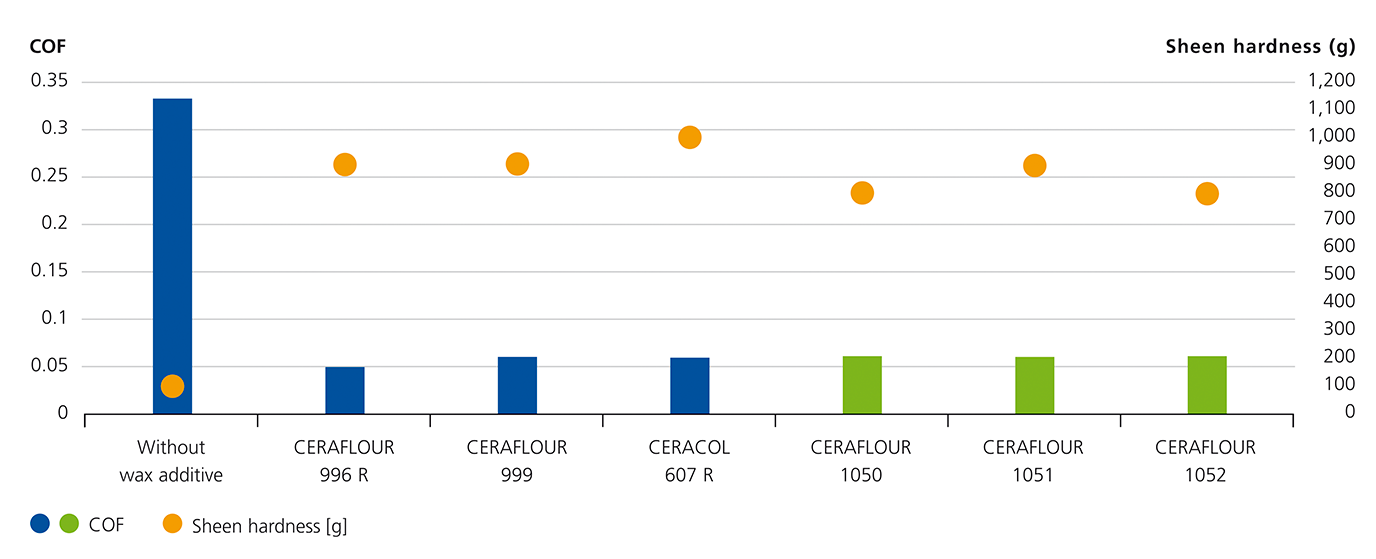
A commonly used test method for evaluating the COF values of surfaces is the Altek 9505 mobility/lubricity tester. By traversing a weight across a sample, the coefficient of friction is determined.(10) Results obtained by these two methods of testing new wax grades can be found in Figure 4. The formulation used is a solvent-based clearcoat, and all wax additives are used with 1% solid wax on total formulation.
Ceraflour 999 and 996 R are micronized wax additives based on PTFE-modified PE wax and serve as the market standard for comparison. Also, a coating sample without wax additive can be found in the figure. The results show that all products can lower the COF of coating surfaces from 0.30 (without wax), to around 0.06 in total. The values between PTFE-based and new PTFE-free products are highly comparable. The same statement is valid for the sheen hardness in this coating. The control sample without the wax additive shows a low performance level with just 100 g of scratch resistance. Using each wax additive, it is possible to increase scratch resistance up to 900 g.

Fig. 4 – Comparison of COF and sheen hardness in a BPA-NI can coating clearcoat

Another area of application that is especially important is coil coatings, where the metal is coated before forming it into the desired shape. The surface of a prepainted metal can be either very matt or high gloss, smooth, orange-peel, or textured. Although the organic coatings used in coil coatings have a lower dry-film thickness than post-applied films such as automotive coatings, they still provide a particularly outstanding mechanical and optical performance. This means that the desired values for COF and abrasion resistance must be precisely reproducible, reliable, and at perfectly adjusted levels to keep the application process running and allow the cutting and forming of all part types after the coating process. As well as excellent mechanical performance, the coating must provide constant gloss levels and good leveling with little to no flash-off time after application.(12)An effective way to evaluate abrasion resistance in coil coatings is the Taber test. For this test, a test panel, is mounted to a turntable platform that rotates on a vertical axis at a fixed speed. Two Taber-abrasive wheels, perform a characteristic rubbing-wear action in contact with the test specimen to generate a sliding rotation of the two abrading wheels.(13)

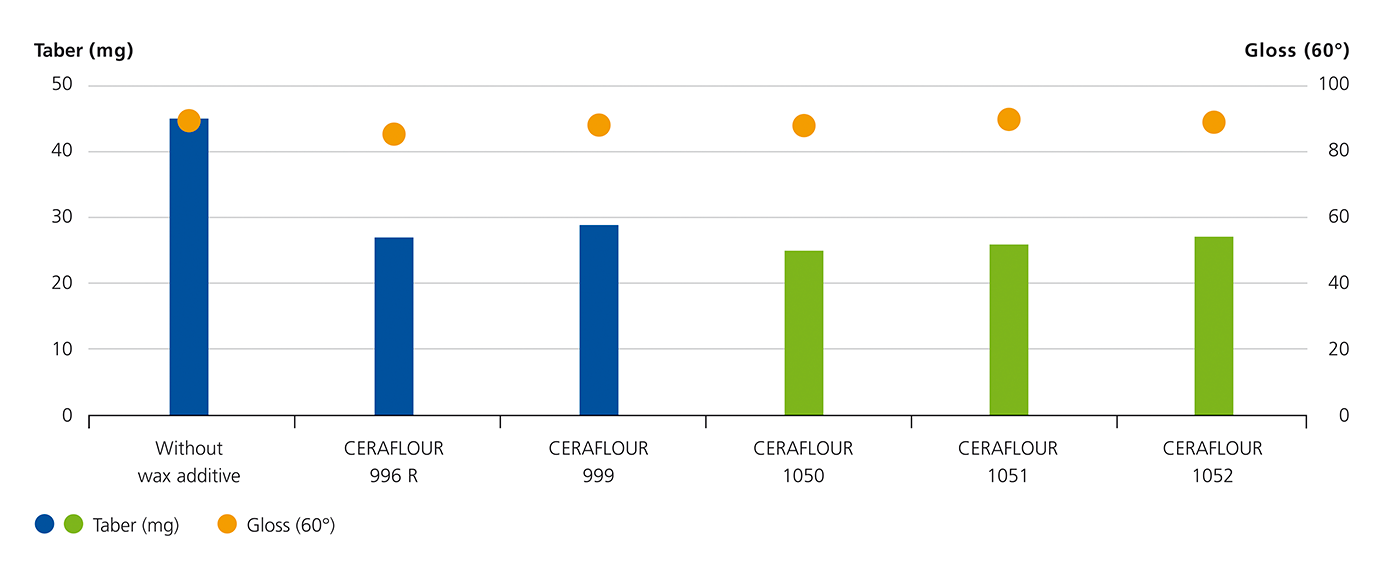
Fig. 5 – Comparison of Taber abrasion and gloss in polyester/melamine coil coating

The loss of weight is measured in milligrams after a specified number of rotating cycles. In Figure 5, the wax additives Ceraflour 996 R and 999 again serve as market standards for comparison with this solvent-based polyester/melamine coil coating system. All wax additives are used with 1% solid wax on total formulation. This shows that new wax additives Ceraflour 1050, 1051 and 1052 can offer an abrasion resistance that is highly comparable to the PTFE-based standards.
Another particularly important area of application for PTFE-based wax additives is the broad area of general industrial coatings, ranging from coatings for computers or consumer electronics through DIY aerosol and drum coatings to coatings for agriculture, farming equipment, and automotive interiors. They can be solvent-based, solvent-free, or aqueous, but one thing these coatings have in common is that they need to be scratch and abrasion resistant. One additional test method in this area of application is abrasion testing according to Wazau SN 27650. The device determines the abrasion resistance of coatings. It is suitable for surfaces that are exposed to minor mechanical stress, such as friction with textiles or paper. A paper tape is pulled over a coated plate at a constant speed. The measure for abrasion resistance is the length of the paper tape in centimeters needed to make the carrier material visible. Additionally, a desired value in centimeters can be set to which the paper is required to move over the specimen.((14)
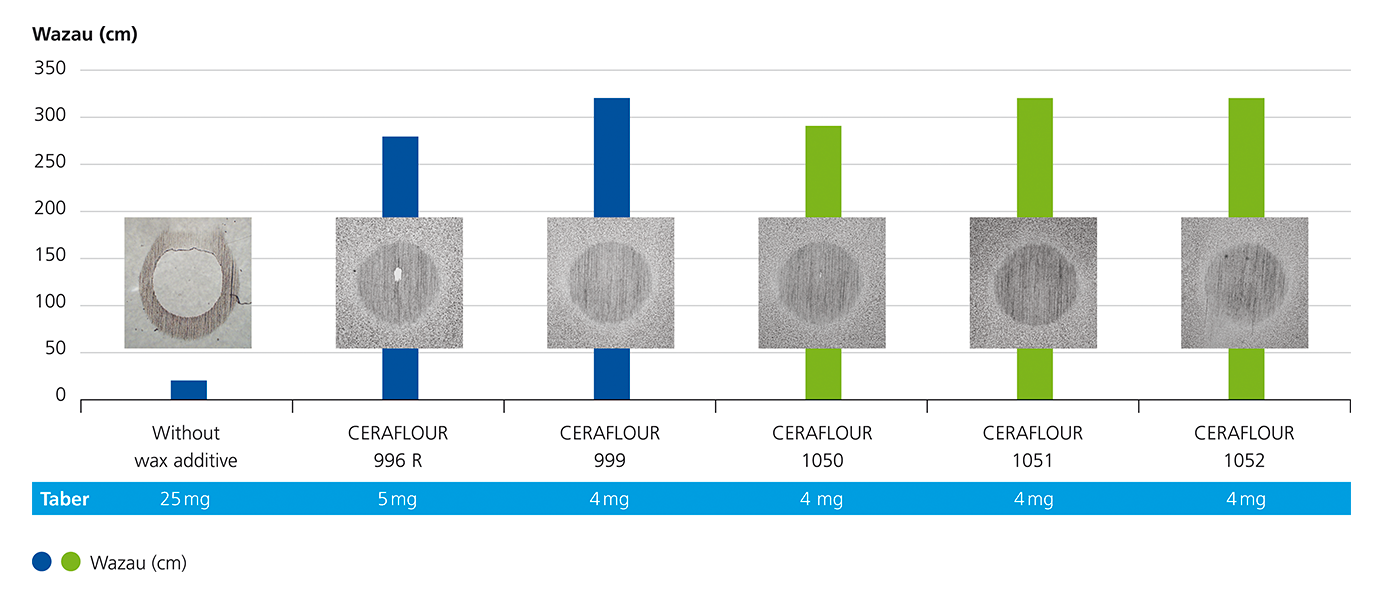
The new PTFE-free products are evaluated in an aqueous one-pack acrylic emulsion with 10% organic cosolvent content for Wazau abrasion and Taber abrasion. Each wax additive is used with 2% solid wax on total formulation. The Taber test uses CS10 grinding wheels for 1,000 rounds at 500 g pressure at each side, and the Wazau abrasion test is evaluated at the maximum paper length that the coating can withstand. In addition, each sample is evaluated optically upon exceeding a paper length of 300 cm. The results show that all new PTFE-free products perform very well in the tests. They lower the Taber abrasion from 25 mg in the control sample to 4 mg loss with the new wax additives. The results are highly comparable to both PTFE-based standard wax additives. The Wazau abrasion shows that all new PTFE-free products can withstand mechanical stress as good as PTFE-based products. In particular, the pictures including abrasion after the paper length of 300 cm show less damage to the coating and a more homogenous behavior.

Fig. 6 – Comparison of Taber abrasion and Wazau abrasion in aqueous GI coating

After the evaluation of dozens of samples and assessing them in a wide variety of areas of application, coating systems, it can be concluded that the newly introduced PTFE-free wax additives have the potential to replace PTFE-based PE/PTFE wax additives (Fig. 6).
They can match well-known properties such as abrasion and scratch resistance without the use of PTFE. They represent an alternative to PTFE-based wax additives without the downsides of the harmful impact on human health or the pollution of the environment. The results presented are selected highlights from a wide range of extended testing and development processes and offer an overview of the potential that these new products offer.

References
1Streitberger, G. Lackiertechnik. 2002.
2Nanetti, P. Lackrohstoffkunde. 2009.
3ECHA. (2023, January). https://echa.europa.eu/hot-topics/perfluoroalkyl-chemicals-pfas.
4EPA. (2023, January). https://www.epa.gov/pfas.
5OECD. (2023, January). https://www.oecd.org/chemicalsafety/portal-perfluorinated-chemicals.
6BYK Regulatory. (2023, January). https://www.byk.com/en/service/regulatory-affairs/food-contact.
7ICS. (2023, January). https://chemsec.org/.
8Siliconexpert. (2023, January). https://www.siliconexpert.com/pfas-usa/.
9Industrial Physics. (2023,January). https://industrialphysics.comproductmechanised-scratch-tester-705/.
10Altek. (2023, January). http://www.altekcompany.com/tech/productspecs/9505AE.pdf.
12Sander, J. Coil Coating. 2014.
13Taber. (2023, January). https://www.taberindustries.com/taber-rotary-abraser.
14Wazau. (2023, January). http://www.wazau.com/en/products/materialtesting/tribology/surface-testing/abrasion-testing-device-apg-sn-27650.html.

DOWNLOAD THE PDF FILE