David Giner, Luciano Cuesta – SEPIOLSA
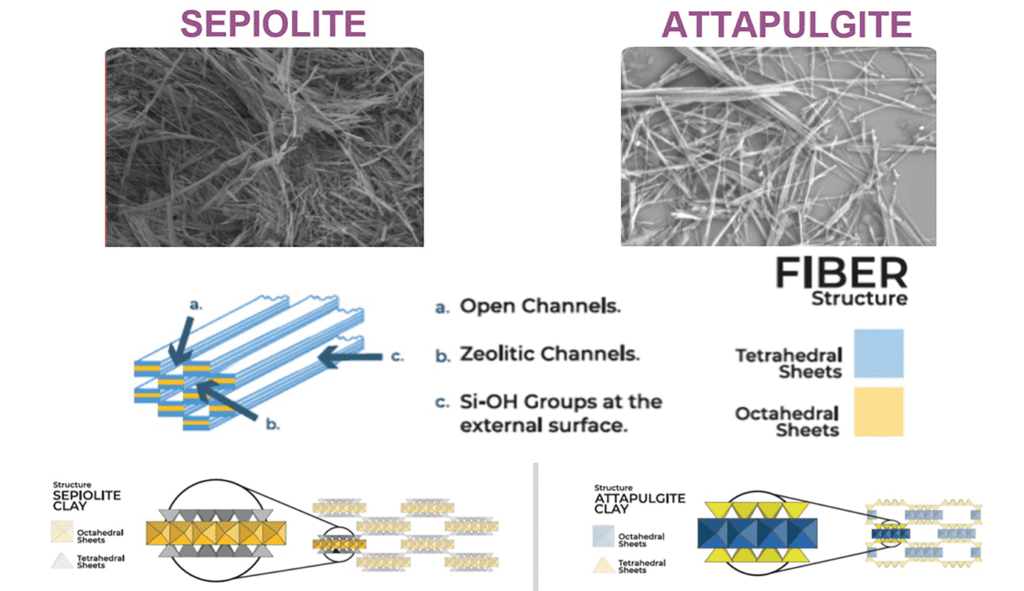
Sepiolite and attapulgite clays are natural, fibrous clay minerals known for their great absorption and rheological properties. When incorporated into materials such as renders, plasters, skim coats, and wall putty, these clays go beyond mere rheology and thickening effects – they significantly enhance the overall quality of the products they are added to. Sepiolite and Attapulgite clays have a unique structure with tiny needle-like particles that hydrate but don’t swell. They also have chemical properties that let them form hydrogen bonds on their surface, which is covered with OH groups. These clays work well with traditional thickeners, especially modified or unmodified cellulose derivatives. They are cost-effective compared to other materials and can even help to reduce the amount of more expensive thickeners used. The benefits they bring, like pseudoplasticity and thixotropy, significantly improve workability, the final appearance, sag control, stability, and ultimately, the quality of the end product. We believe these advantages are so impressive that these additives should be a MUST in any formulation, especially for construction materials like renders, plasters, skim coats, and wall putty, where good workability and an excellent final surface appearance are crucial.
Sepiolite & attapulgite clays
Sepiolite is a naturally occurring hydrated magnesium silicate characterized by its microfibrous morphology and distinctive texture, providing a high specific surface area ranging from about 200 to 350 m²/g. Originating from sedimentary deposits, Sepiolite is a nonswelling, lightweight, and porous clay with remarkable absorption capacity due to its high surface area and porosity. Most of the world’s sepiolite production comes from sedimentary deposits near Madrid, Spain. Attapulgite clays, also known as Palygorskite, are crystalline hydrated magnesium aluminum silicates with a unique chain structure, contributing to their unusual colloidal and sorptive properties. Major deposits of attapulgite, are relatively rare globally, with significant occurrences in the USA, Senegal, and China. Producers of sepiolite and attapulgite clays can customize these clays to create various grades by employing fiber treatments, activations, and adjusting particle sizes. These different grades offer distinctions in dispersibility, stabilization capacity, viscosity, and even the degree of thixotropy. In essence, this flexibility allows manufacturers to tailor these clays to meet specific requirements for different applications, contributing to their versatility and wide-ranging use in the construction industry. As an example, Rheoplus sepiolite and attapulgite clays, extracted and produced by Sepiolsa, stand out globally for their exceptional purity as well as a wide range tailored for each application and manufactured using the latest mineral processing technology.
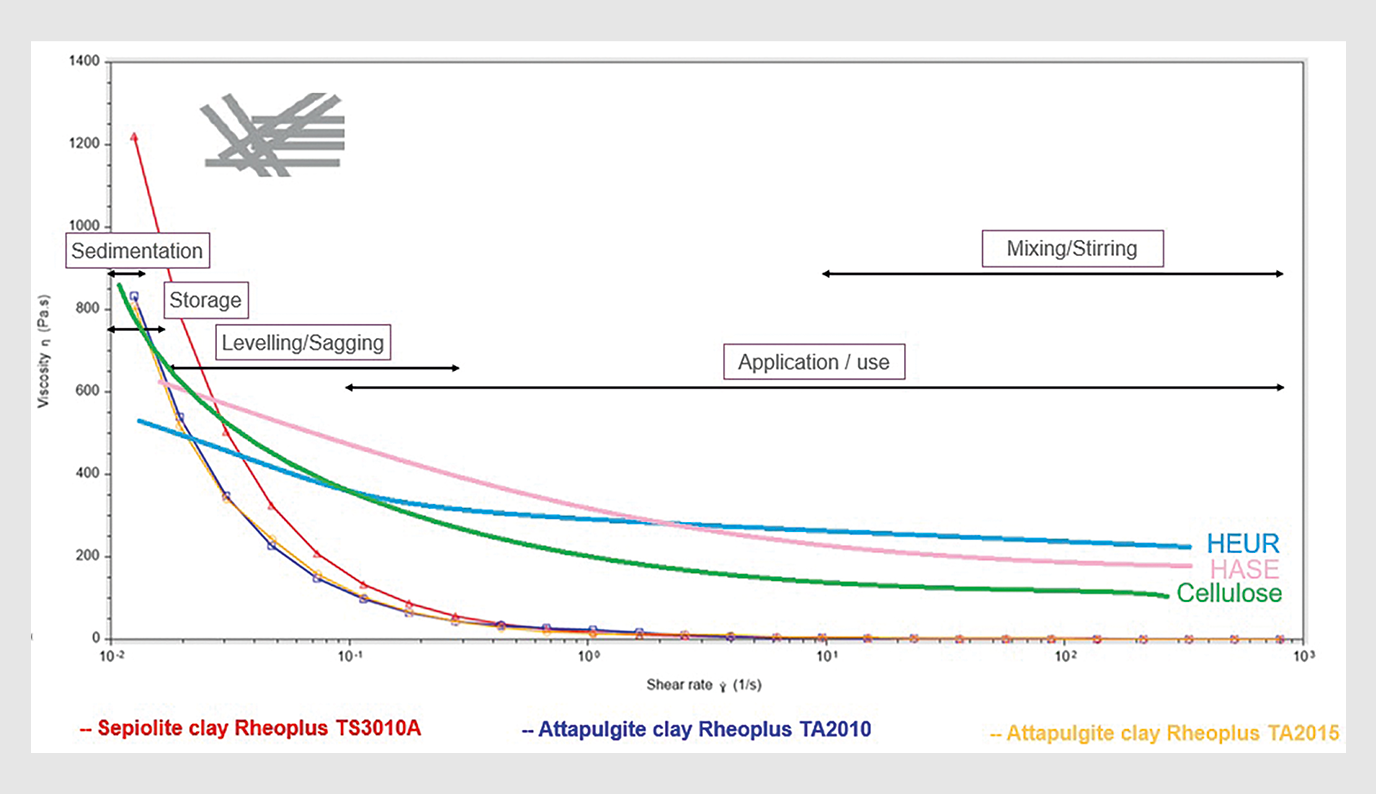
Fig. 2 -Pseudoplastic behavior of sepiolite clay Rheoplus TS3010A and attapulgite clays Rheoplus TA2010 and Rheoplus TA2015. It’s worth noting that the pseudoplastic behavior of sepiolite clays is slightly more pronounced than that of attapulgite Clays.
One step beyond rheology
The incorporation of sepiolite and attapulgite clays in materials like renders, plasters, skim coats, and wall putty plays a pivotal role in optimizing various crucial factors, ensuring enhanced workability, sagging control, pumpability, and a flawless final surface finish, all while preventing the development of cracks. A key aspect lies in the strategic combination of organic rheology modifiers, such as cellulose derivatives, HEUR, HASE, Acrylics, with sepiolite and attapulgite clays in formulations. This synergistic approach generates remarkable effects, fine-tuning performance to meet the highest standards. The abundance of Si-OH groups on the surface of these clays facilitates thixotropy, fostering interaction with both organic and inorganic components in the formulation. This interaction manifests in several observable benefits:
– Improved stability: the dual stabilization mechanisms significantly reduce settling, enhancing overall stability throughout the material.
– Reduced settling and syneresis in ready-mixed preparations: – this prevents pigment and filler settling by bolstering gel strength. It ensures good workability and offers stability during transportation and storage, preventing undesirable changes.
– improved application properties: – the presence of sepiolite and attapulgite clays facilitates easier application, providing a superior user experience and enhanced workability, ultimately translating to a better end product.
– cost efficiency: by diminishing the need for more expensive organic alternatives, and in some instances, allowing partial replacements of other organic rheology modifiers, the use of sepiolite and attapulgite clays proves to be a cost-effective solution, ensuring high performance without compromising on financial considerations.
The combination of these clays with organic rheology modifiers represents a sophisticated approach to formulation, unlocking a spectrum of advantages that contribute to the overall excellence and efficiency of construction materials, especially those focused on coat, smooth and level wall surfaces before painting such as renders, plasters, skim coats and wall putty (no matter if applied by hand or by mechanized methods such as spraying).
Pseudoplasticity and thixotropy
Sepiolite and attapulgite clays display a robust pseudoplastic behavior, even more pronounced when compared to other commonly used rheology modifiers. At low shear rates, systems containing sepiolite and attapulgite clays demonstrate non-Newtonian flow, characterized by a gradual decrease in viscosity as the shear rate increases. Beyond a specific shear rate threshold, the flow curve transitions to a linear pattern. The elevated viscosity of these clays provides essential properties at low shear, such as stabilizing the medium against the effects of sedimentation, storage, and leveling. Moreover, their low viscosities as shear increases contribute significantly to improving workability, imparting crucial enhancements to the material’s handling and application properties.
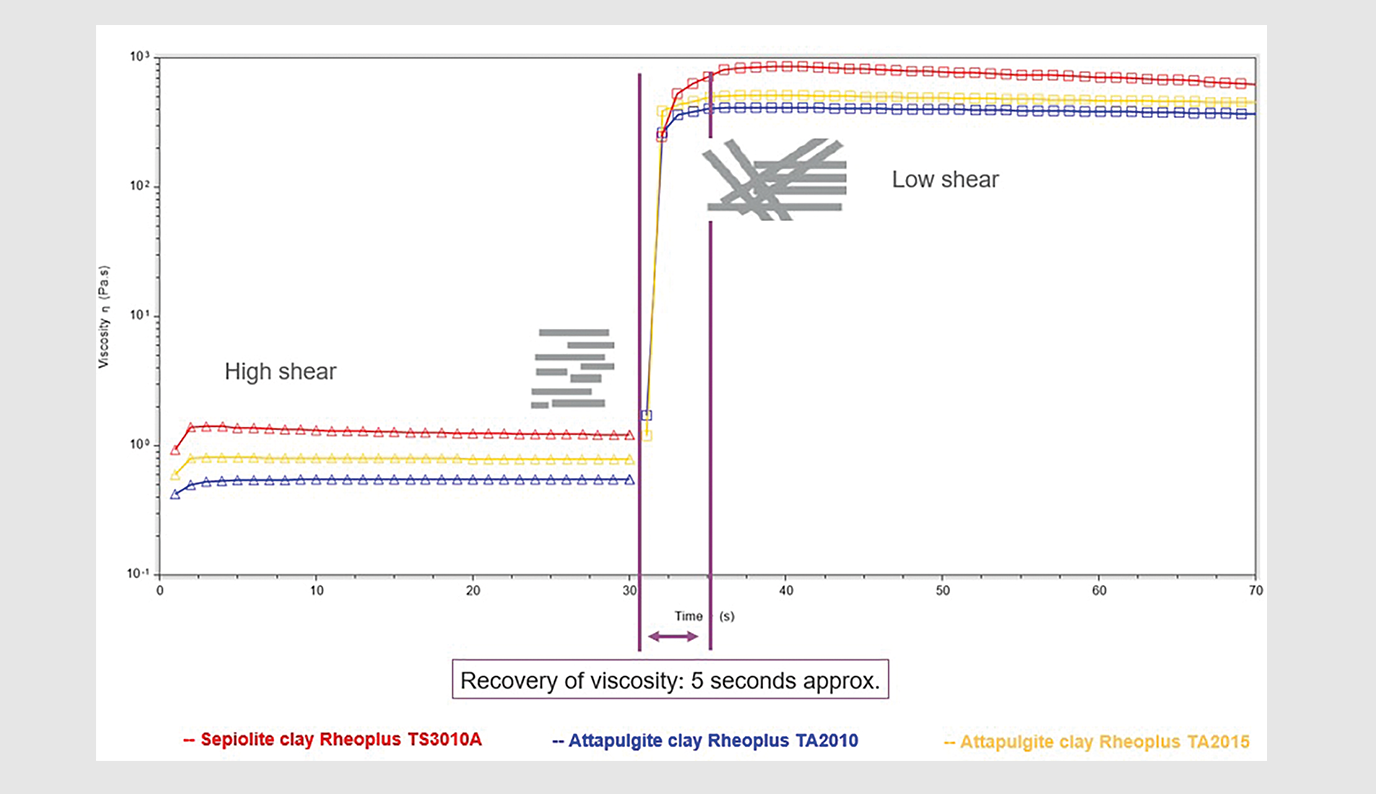
Fig. 3 – Thixotropic behavior observed in sepiolite clay Rheoplus TS3010A and attapulgite clays Rheoplus TA2010 and Rheoplus TA2015 showcases the rapid recovery time. This characteristic is crucial when working with these materials, ensuring excellent workability and preventing sagging during application
Thixotropy understood as recovery time is critical for sagging control and coating leveling. When at rest, the sepiolite and attapulgite gels rapidly regains its high viscosity, providing excellent stability and resistance to sagging. This property makes these materials ideal for applications requiring controlled and stable thickening, such as renders, plasters, skim coats and wall putty formulations. Users benefit from the quick recovery of viscosity after shear, ensuring uniform application and effective suspension of solid particles.
The perfect clay for every application
While, in general, the incorporation of sepiolite and attapulgite clays adds significant value to formulations in renders, plasters, skim coats, and wall putty, the market presents a diverse array of products distinguished by the kind of clay, particle size, rheological properties, and viscosity. Within its Rheoplus range, Sepiolsa stands out by offering the widest variety of products derived from both clays, coupled with exceptional technical advisory services for product formulation.
In Italy these products are distributed by Brenntag.