Bio-based energy curable oligomers

Darren Lumber – RAHN AG

RAHN has been promoting UV/EB curing for over 30 years, which is recognized as a green technology. Compared with conventional curing technologies, significant CO2 savings can be made, reducing greenhouse gas emissions and decreasing our carbon footprint. RAHN’s new bio-based energy curable oligomers are a testament to the company’s commitment to sustainability. Bio-based materials can have an improved environmental profile. In using them, one can contribute to a low carbon economy because as they grow, they take up CO2. The company has several interesting products in its range for this approach. RAHN also has the expertise to develop customized solutions.

Advantages for UV curing technology
To improve the sustainability aspects further, one can use bio-based materials in the UV formulation. Compared with conventional curing technologies, significant CO2e (Carbon dioxide equivalent) savings can be made and thus reducing greenhouse gas emissions and decreases our carbon footprint. UV/EB curing does not need large ovens, often burning methane gas, does not have solvent emissions that require further processing or burning and requires a smaller physical footprint to dry (actually, to cure). UV/EB coatings tend to be classed as 100 % solids, so the film weight you apply is the one that remains. This means you need less ink or coating compared to conventional systems and there is no excess solvent or water being transported around the globe.

Fig. 1 – Oil based vs bio-based products

Oil based vs bio-based products
Bio-based materials can have an improved environmental profile. In using them, one can contribute to a low carbon economy because as they grow, they take up CO2 (Fig. 1). Whilst at the end of life this CO2 is released back into the atmosphere, it is not adding new CO2 as when using oil. In some cases, bio-based products can also give new or superior properties to standard oil-based products.

Segregated vs mass balance
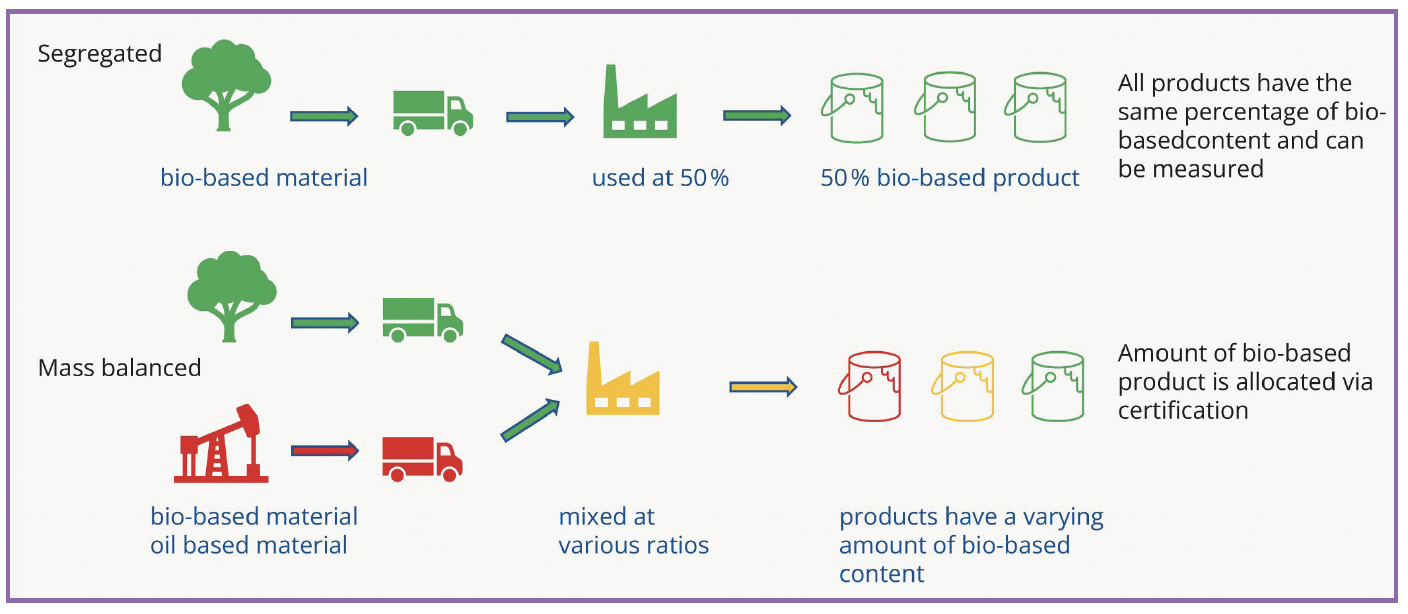
A material is considered “bio-based” if it is completely or partially derived from biomass. These products can also be referred to as bio-renewable or regrowable. In using bio-based products, one removes the reliance on fossil fuels as feedstock materials. Bio-based products can be classed as segregated or mass balanced (Fig. 2). A segregated bio-based product is clearly preferred as then the consumer always knows how much bio-based material is in the product. This can also be measured by C14 analysis (see later), proving the biobased content. However, using mass balanced is a good way to improve the overall volume of bio-based products used in the industry and it is an easier way to integrate materials into the supply chain. This is because with mass balance, bio-based material can be simply added to the current oil-based manufacturing scheme. As the amount of bio-based material varies each time, this needs to be controlled and tracked by verified bookkeeping. The International Sustainability & Carbon Certification is currently the most used certification scheme and is globally accepted.

Fig. 2 – Segregated vs mass balanced

Measuring bio-based content
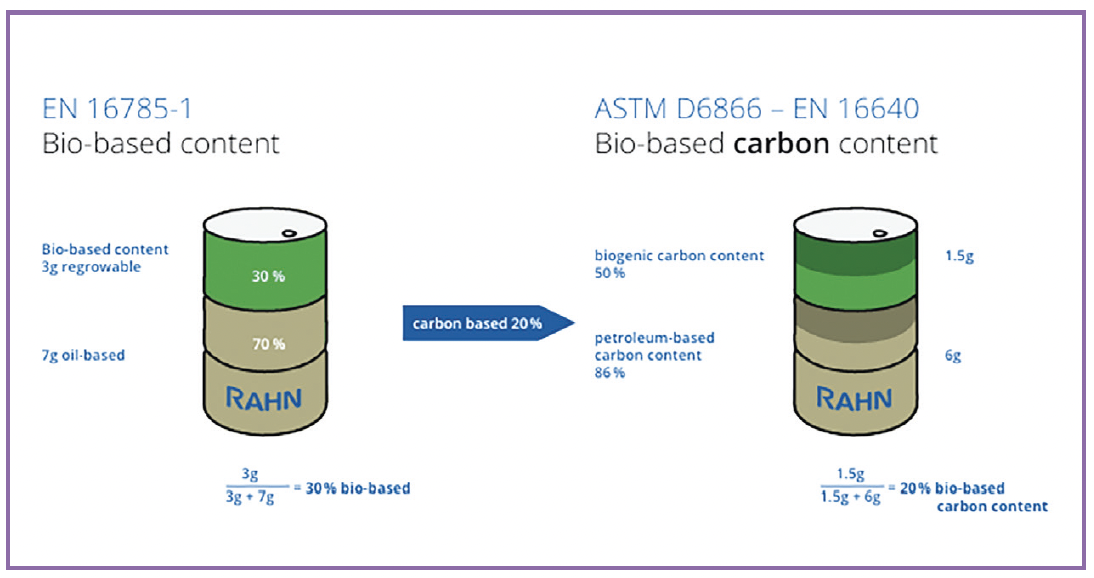
Two main methods used to communicate the bio-based content of raw materials are seen in Figure 3 below. The bio-based carbon content, which uses a quantitative, measurable value of Carbon 14 to calculate the biobased content, and the simpler bio-based content, which is calculated from the total amount of bio-based product used in making the final product (taking account of all carbon, hydrogen, oxygen and nitrogen). These values are not always similar.

Understanding carbon-14 analysis
Carbon-14 originates in the upper atmosphere of the earth and is created when neutrons, originating from solar radiation, collide with nitrogen in the air. This carbon-14 immediately starts to radioactively decay, but as it is constantly being recreated, the amount in the air is relatively constant. This carbon-14 immediately combines with oxygen to form carbon dioxide (CO2), which then becomes part of the carbon cycle. In living organisms, carbon-14 is constantly taken in through photosynthesis or consumption of other organisms.
As a result, the level of carbon-14 in an organism reflects the atmospheric concentration at the time of its growth or consumption. Anything that is more than 50,000 years old no longer has carbon-14 present. So, recently living materials (bio-based content) have Carbon-14 in them, whilst fossil materials no longer have. To establish the biobased content of a material, the mea-
sured carbon-14 ratio is compared to a known ratio for mo-
dern, biogenic carbon. By quantifying the difference, the proportion of biobased carbon in a material can be determined.

Fig. 3 – Different ways to measure the bio-based content

This method is known as ATSM D6866. It should be noted that the bio-based content of a material is not an indicator of the biodegradability of the material and not all bio-based bioplastics are biodegradable.

Highlighted bio-based products from RAHN
- Genomer* 3135 is a low viscosity bio-based polyester acrylate resin for UV/EB free radical-curable inks, coatings, adhesives and 3D printing, exhibiting excellent flexibility and elongation. Bio-renewable content is 65%.
- Genomer* 3143 is a bio-based aliphatic polyester acrylate. Resin for radically curable inks and coatings, adhesives and 3D-printing. Bio-renewable content is 81%.
• Hard and scratch resistant when cool.
• Tacky at elevated temperature.
• Heat and pressure can laminate substrates.
– Genomer* 4293 is a bio-based aliphatic polyester urethane acrylate. Resin for radically curable inks and coatings, adhesives and 3D printing. Bio-renewable content is 56%. The high viscosity can be rapidly reduced by adding reactive diluent.

DOWNLOAD THE PDF FILE